
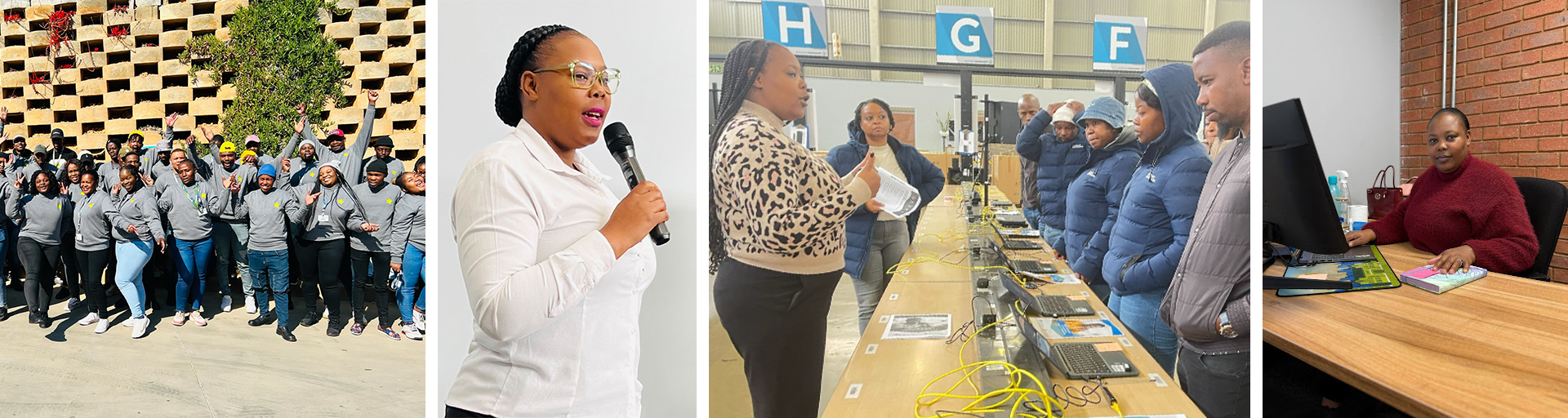
Mapule grew up in Gauteng. She studied, entered the workforce, and took her first job as an IT intern. She never imagined she would one day lead customer success for a company supporting schools across Africa. Her story shows something many learners don’t yet know: careers in education technology don’t follow a straight line, and many of them don’t even have names yet when you’re sitting in a classroom.
The challenge: young people can't picture jobs they've never heard of
Learners are often asked what they want to be when they grow up. But how do you choose a career you’ve never heard of? Roles like data analyst, digital learning specialist, or customer success manager barely existed when many of today’s workforce were at school. Without visibility into these paths, talented young people can rule themselves out of industries that would value exactly what they offer.
Mapule’s journey is proof of what’s possible when that visibility exists.
The human story: from casual worker to customer success manager
In 2014, Mapule worked on a small digital education project at Snapplify, alongside a team. When the project ended, so did the internship. Before leaving, her manager gave her the kind of promise that easily gets forgotten: “If we ever have work in Johannesburg, I will call you.”
Two years later, in November 2016, the call came. There was work. She started the next day, with no title and no fixed hours, just three days a week as a casual worker.
From there, her path moved forward through consistent effort: casual worker, team leader, supervisor, and eventually customer success manager. Each step followed the same pattern: performance, responsibility, and a willingness to keep learning.
“Nobody promoted me because I was lucky,” she says. “People trusted me because I consistently delivered.”
The practical response: growth built on real opportunity
Mapule’s rise mirrors the growth of the project she joined. What began as a small digital learning initiative has scaled into a large operation supporting schools with devices and digital content across multiple provinces.
The work itself has changed too. Early projects relied on manual processes; devices prepared by hand, content packages built overnight on multiple computers. Today, automated systems handle data, run quality checks, and speed up delivery at a scale the original team could barely have imagined.
Real examples: growth you can measure
- Up to 100,000 devices prepared during back-to-school periods
- Up to 80 casual workers employed across multiple shifts
- Seven-day operations at a large-scale production facility
- A nine-year career path from manufacturing to customer success management
Behind every number is a team. Mapule points to the people she worked alongside during training sessions, warehouse shifts, and team celebrations as proof that technology doesn’t replace people. Great people use it to achieve more.
What this means for learners today
Careers in educational technology now include roles such as project manager, data analyst, software developer, AI engineer, content specialist, and device technician. These jobs barely existed a decade ago and will continue to evolve as technology does. Mapule’s advice to her Grade 12 self applies just as well to any learner today: work hard, keep learning, be dependable, don’t be afraid of technology, take opportunities, ask questions, and start before you feel ready.
As she puts it: “The next success story could be you.”